Tanja Ahlin*
When I first introduced the notion of “field events” with my co-author Fangfang Li (Ahlin and Li 2019), digital technologies were becoming more common in ethnographic fieldwork, but they were still not the most popular. Only one year after the initial publication, the onset of the Covid-19 pandemic forced ethnographers around the world to incorporate these devices into their methodology as funding agencies required the suspension of face-to-face fieldwork (Cabalquinto and Ahlin 2023). Since then, the concept of field events has become even more analytically salient.
What are digital field events? In short, digital field events are moments of ethnographic significance that are co-created by ethnographers, their interlocutors and the digital technologies that they use to communicate with each other. Each field event is shaped in particular ways, depending on who is involved and the kinds of digital devices that are used. In choosing the devices and platforms, the ethnographers generally follow their interlocutors’ preferences and habits rather than the other way around. In doing so, it is important to recognize that there is no such thing as “technology”; there are only specific technologies, each with their own affordances that allow people to include them in certain practices, in certain ways (Pols 2017).
Beyond exploring how people around the world appropriate and creatively engage with digital technologies such as social media, field events foreground both explicit and more subtle influences of technologies on people. Recognizing the role of digital technologies in shaping field encounters highlights that they are not just tools of communication; instead they actively impact people, how they relate to each other through practices such as ‘doing fieldwork,’ and what kind of data can be obtained through them. In what follows, I first show how field events, despite seemingly collapsing distance between people, remain grounded in various specific geographical locations. I then explore the importance of the temporal dimension of field events and conclude by arguing for the importance of in-depth participant observation through and as an addition to field events.
Where are we?
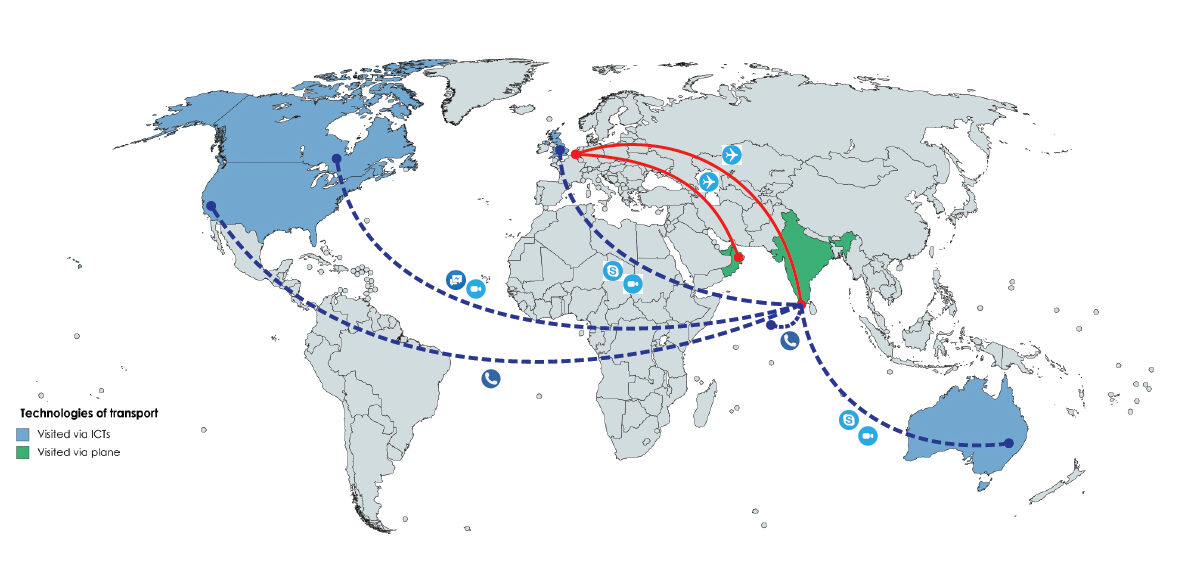
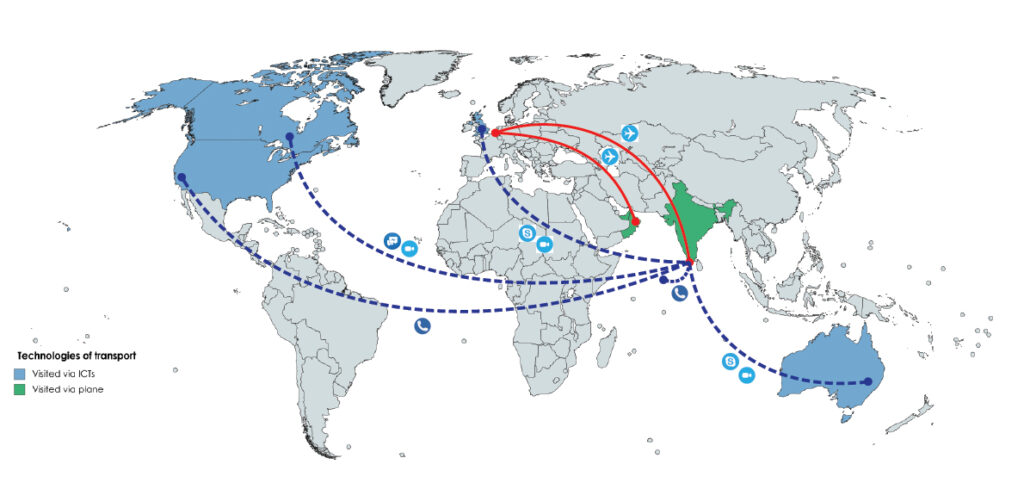
Importantly, the notion of field events came about as a way to re-conceptualize the ethnographic fieldsite. During my research on elder care with digital technologies in transnational families of nurses from Kerala, South India (Ahlin 2023), colleagues asked me about the location of my fieldsite. Field-events were born out of my frustration of not knowing how to answer this question. As the image below shows (Figure 1), I visited India and Oman as two fieldsites; this research design fitted well with the method of following people across multiple sites (Marcus 1995). But during fieldwork, my interlocutors also invited me to talk to their family members in different parts of the world, from the United States to Germany, the Maldives and Australia via mobile phones and video calls on Skype and Facebook Messenger. How to conceptualize a fieldsite that encompasses geographic locations that I visited in person as well as the multiple and highly diverse locations where my interlocutors were situated, but I did not visit by traveling there?
In an attempt to go beyond thinking in online/offline and actual/virtual dichotomies, the notion of field events shifts the focus from the field as something that is situated in geographic and social spaces (‘sites’). It builds on the work by Doreen Massey (2005) and Sarah Pink (2011) who proposed to consider places in terms of spatio-temporal events. Field events propose an understanding of fieldsites as a constellation of events, enacted through practices that include ethnographers, their interlocutors and digital technologies.
In doing so, geographical space does not become any less important. To start with, space becomes tangible as people co-create field events across different time zones (see also Boellstorff 2012). People still reside in their bodies which very much reside in physical locations. These environments influence when people wake up and go to bed, what kind of food they eat, who they socialize with and how, where and how they work, how much leave they obtain to visit their family in person and how are their movements and family connections ruled by employment opportunities and immigration policies.
Additionally, field events depend on the broader context in which they take place, such as national telecommunication regulations of the countries in which the interlocutors are based and even their environmental, political and institutional contexts. Digital technologies do not exist in a vacuum, but are embedded in, and shaped by, particular sociopolitical arrangements (Edwards 2003). As people engage with digital technologies, these material arrangements and infrastructures become “absent presence” – not necessarily immediately visible, but crucial for the functioning of technologies (Law 2002). These infrastructures – material, environmental and sociopolitical – are very much grounded in specific geographic spaces.
Shifting times
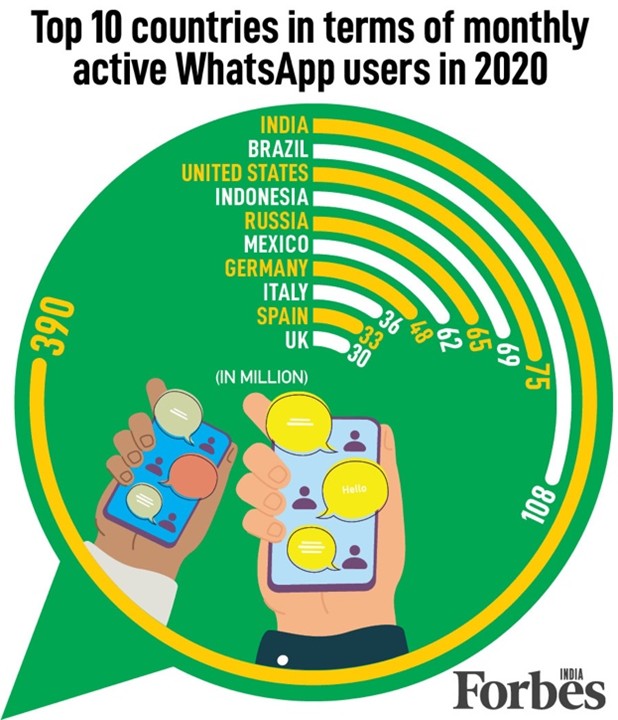
Digital technologies influence fieldsites not only in terms of space, but also temporality, for both researchers and their interlocutors. To start with, these technologies continuously evolve at what feels like a faster pace than ever. The fieldwork underlying my field events was conducted in 2014–2015 and extended into the pandemic period until 2022. During this time span, digital technologies and their use, including in family care practices which I was studying, changed considerably. In India, one platform spread more than in any other country in the world: WhatsApp (Jain 2021; Baruah 2021, Figure 2). This proliferation profoundly impacted the kind of field events I enacted together with my interlocutors, including switching between synchronous and asynchronous communication.
Several interlocutors whom I contacted during the pandemic were happy to interact with me on WhatsApp in modes I was not used to before, at all times of day. I vividly remember a warm early autumn afternoon when I took a break from writing and went for a walk in the woods. In the middle of the forest, I suddenly received a WhatsApp response from a nurse which I had been waiting on for days. I didn’t want to risk losing this opportunity to connect by postponing our conversation, so I decided for a WhatsApp exchange there and then. In contrast with my previous field events, this one occurred in a semi-synchronous manner, through audio messages. In this way, the connection was not continuous, but punctuated by short periods of temporal gaps as I was waiting for new messages to appear. The field event continued with her sending me a PDF document of her wedding photographs through WhatsApp and me asking additional follow-up questions through text messages, to which I only got short and rather shallow responses. The field event in this case encompassed the whole time of interaction, punctuated by gaps in time that made the interaction rather frustrating. At the same time, even this event enabled me to obtain some valuable data.
Yet in other, synchronous, field events I had extended conversations with people living in locations spanning from the United Kingdom (UK) to Australia. One of these conversations was particularly rich, as my interlocutor, whom I call Aaron, talked about the intensity with which he communicated with his parents during a health emergency. His father, a chronic lung patient, had contracted Covid19, but for Aaron, who was an only son and lived in the UK at that time, it was impossible to travel to India due to travel restrictions. This is how he described his experience:
During that time, my mom was calling me all the time, every ten minutes, even during my work time. So I couldn’t concentrate on my work, and I had to take a week of leave. … I was absolutely stressed out. I was constantly on the phone, but at least in this way I was there for my mother, on the phone. My mom and I always talk through a video call on WhatsApp. She’s illiterate and doesn’t speak English, but I taught her to use WhatsApp before I left to the UK, and she’s completely comfortable with it. So my mom could see me, and I explained to her, go left, go right, speak to that person, fill out this form.
This excerpt from our conversation carries methodological and empirical significance. On the one hand, it illustrates that field events may generate rich narratives; on the other hand, it highlights the impact of frequent interaction through visual digital technologies on people’s care practices as well as experience of time and space.
This resonates with Patty Gray’s (2016) conceptual re-focusing of fieldwork from location to temporality. In her work on following protests through multiple digital technologies, Gray articulates a useful shift: from “being there,” so physically present in a specific location, to “being then,” referring to temporal co-presence with people in different geographic locations, an experience which is made possible and mediated by digital technologies. In such instances, physical co-presence becomes overshadowed by the shared experience of tuning into unfolding events at the same time, from different places. Aaron’s situation during his parents’ health crisis demonstrates this well. His attention was so intensely concentrated on Kerala that he had to take a leave from work as he was afraid of committing mistakes. Unable to be there in Kerala, he was then with his parents through WhatsApp.
This conflation of temporal and spatial dimensions through digitally enabled experience of being then points towards a broader theoretical discussion, that of “hybrid space” (e.g. Kaufmann and Palmberger 2022; Przybylski 2021). Scholars have theorized hybrid spaces as the “blending of physical and digital spaces produced by the mobility of people communicating via mobile technologies” (De Souza E Silva et al. 2025, 14). A result of changing sociotechnical landscapes, hybrid spaces are not simply spaces that people occupy but ones they actively produce as they move through the world with their portable devices, constantly connected to the Internet.
Yet mobility alone does not account for all the ways hybrid spaces are produced. Intensity of interaction matters too; this has a temporal dimension, which is not necessarily enacted through duration of contact but its frequency (Ahlin 2020). When communication through digital technologies becomes sufficiently intense through frequent interaction, what unfolds in the hybrid space may become overwhelming to the point where one’s connection to the immediate world around them becomes compromised. This was the case for Aaron, who took leave from work for this reason, and also for Gray during the months of her remote fieldwork: her colleagues commented that they were “a little worried” about her at the height of her absorption in the hybrid space of protests in Russia while being physically situated in Ireland (Gray 2016, 502).
In both cases, the intensity of digital interaction produced a hybrid space through the force of sustained temporal co-presence, collapsing the distance between here and there through the sheer weight of being then. Such being then across various physical locations through intense interaction and focused attention through digital technologies importantly contributes to enacting the encounters of ethnographers with their interlocutors as field events.
Keeping participant observation in
As digital technologies evolve further, and ethnographic research practices with them, the notion of field events remains increasingly relevant, as it invites ethnographers to continuously ask what “good fieldwork” with digital technologies is (e.g. Jovicic 2022). It demands transparency and critical reflection about which human and non-human actors participate in each specific field event, how and under what conditions, and with what consequences for the ethnographic data, the interlocutors, the ethnographer and the relationships between them.
The possibilities of enacting field events with the help of digital technologies do not diminish the significance of geographic space and traveling for fieldwork, whether across countries, continents, or cities. As Gray (2016) notes, her remote fieldwork was only fruitful because she had previously become familiar with the physical locations in question. In my fieldwork, rich field events became enacted because I had first physically visited Kerala, encountered people in person and was then referred to contact potential interlocutors through digital technologies. It is telling, for example, that during our first phone call one nurse exclaimed: “Yes, I know you!” We had never met in person, but she told me that her parents had informed her about me and instructed her to speak to me. In-person connections thus carry particular weight for trusting relations, even when they are done by proxy.
Finally, it is key not to flatten the practice of fieldwork through digital technologies to online interviews (see also Boellstorff 2012). If digital field events are to uphold the standards of ethnographic fieldwork, ethnographers must actively consider how depth of participant observation can be maintained. This means not only complementing field events with in-person fieldwork (being there) whenever possible, but also paying attention to what it means to be in the hybrid space (being then). Ultimately, the concept of digital field events challenges the ethnographers to be attentive and present, not just in place, but in the full complexity of the encounter as it unfolds across physical, online and hybrid spaces.
References
- Ahlin, Tanja. 2020. ‘Frequent Callers: “Good Care” with ICTs in Indian Transnational Families’. Medical Anthropology 39 (1): 69–82. https://doi.org/10.1080/01459740.2018.1532424.
- Ahlin, Tanja. 2023. Calling Family: Digital Technologies and the Making of Transnational Care Collectives. Rutgers University Press.
- Ahlin, Tanja, and Fangfang Li. 2019. ‘From Field Sites to Field Events’. Medicine Anthropology Theory 6 (2): 2. https://doi.org/10.17157/mat.6.2.655.
- Baruah, Varun. 2021. ‘The Secret To a Successful Digital Rural Marketing- The New Avatar’. LinkedIn, September 8. https://www.linkedin.com/pulse/secret-successful-digital-rural-marketing-new-avatar-varun-baruah/.
- Boellstorff, Tom. 2012. ‘Rethinking Digital Anthropology’. In Digital Anthropology, edited by Heather A. Horst and Daniel Miller. Bloomsbury Publishing.
- Cabalquinto, Earvin, and Tanja Ahlin. 2023. ‘Researching (Im)Mobile Lives during a Lockdown: Reconceptualizing Remote Interviews as Field Events’. International Journal of Cultural Studies, March 14, 136787792311574. https://doi.org/10.1177/13678779231157428.
- De Souza E Silva, Adriana, Scott W. Campbell, and Rich Ling. 2025. ‘Hybrid Space Revisited: From Concept toward Theory’. Communication Theory 35 (1): 14–24. https://doi.org/10.1093/ct/qtae023.
- Edwards, Paul. 2003. ‘Infrastructure and Modernity: Force, Time and Social Organization in the History of Sociotechnical Systems’. In Modernity and Technology, edited by Thomas J. Misa, Philip Brey, and Andrew Feenberg. The MIT Press.
- Gray, Patty A. 2016. ‘Memory, Body, and the Online Researcher: Following Russian Street Demonstrations via Social Media’. American Ethnologist 43 (3): 500–510. https://doi.org/10.1111/amet.12342.
- Jain, Samidha. 2021. ‘Indians Most Active On WhatsApp With 390.1 Million Monthly Active Users In 2020’. Forbes India, August 27. https://www.forbesindia.com/article/news-by-numbers/indians-most-active-on-whatsapp-with-3901-million-monthly-active-users-in-2020/70059/1.
- Jovicic, Suzana. 2022. ‘The Affective Triad: Smartphone in the Ethnographic Encounter’. Media and Communication 10 (3): 225–35.
- Kaufmann, Katja, and Monika Palmberger. 2022. ‘Doing Research at Online and Offline Intersections: Bringing Together Digital and Mobile Methodologies’. Media and Communication 10 (3): 219–24.
- Law, John. 2002. ‘On Hidden Heterogeneities: Complexity, Formalism and Aircraft Design’. In Complexities: Social Studies of Knowledge Practices, edited by John Law and Annemarie Mol. Duke University Press.
- Marcus, George E. 1995. ‘Ethnography in/of the World System: The Emergence of Multi-Sited Ethnography’. Annual Review of Anthropology 24 (1): 95–117. https://doi.org/10.1146/annurev.an.24.100195.000523.
- Massey, Doreen. 2005. For Space. SAGE.
- Pink, Sarah. 2011. ‘Sensory Digital Photography: Re-Thinking “Moving” and the Image’. Visual Studies 26 (1): 4–13. https://doi.org/10.1080/1472586X.2011.548484.
- Pols, Jeannette. 2017. ‘Good Relations with Technology: Empirical Ethics and Aesthetics in Care’. Nursing Philosophy 18 (1): e12154. https://doi.org/10.1111/nup.12154.
- Przybylski, Liz. 2021. Hybrid Ethnography: Online, Offline, and In Between. SAGE Publications.
*Tanja Ahlin is a Research Fellow at Leiden University and a PI on the NWO Veni project “Paw Support” on animal-shaped social robots in elder care. An anthropologist of health and technology working at the intersection of anthropology and STS, she studies what constitutes a good life with digital technologies. She is also a Visiting Professor at KU Leuven and the author of Calling Family: Digital technologies and the Making of Transnational Care Collectives.
Acknowledgement
Thanks to Suzana Jovicic and Monika Palmberger for their constructive comments to earlier drafts of this post.