Kamilla Péter*
This blog post is a revision of a text created for the seminar “Digital Identities and Socialities” by Philipp Budka for the MA programme “CREOLE – Cultural Differences and Transnational Processes” at the University of Vienna. All images are sketches by the author (21 January 2026), replacing copyrighted images owned by the Walt Disney Company.
Once Upon a Time…
In this blog post, I examine the Walt Disney Company’s depiction of the Evil Queen on its official Facebook page. I particularly focus on gendered visual features across a corpus of twenty-four still images posted between 2014 and 2025, a period leading up to the release of the live-action Snow White (2025), the most recent adaptation of Snow White and the Seven Dwarfs. I perceive these images as a reproduction of socio-cultural and political practices (Cruzl and Thornham, 2015). Thus, I treat the portrayals of the Evil Queen as “identity texts,” so that the stills can be read as layers of meaning (Wohlwend, 2012).
This approach is aligned with Stuart Hall’s encoding/decoding theory, which acknowledges that viewers actively interpret the meanings of on-screen messages (1997). Therefore, I address two research questions: first, how gender is visually constructed across the various portrayals of the Evil Queen; and second, how her representation has changed over time.
Menacing Witch
The Evil Queen has two dominant visual forms: the regal Queen and the Witch, both of which originate from Disney’s first feature-length animated film, Snow White and the Seven Dwarfs (1937). Her regal portrayal is frequently hyperfeminine, especially when contrasted with Snow White’s “natural” femininity. By contrast, her Witch form is masculinised, destabilising heteronormative expectations of how a woman should be portrayed.
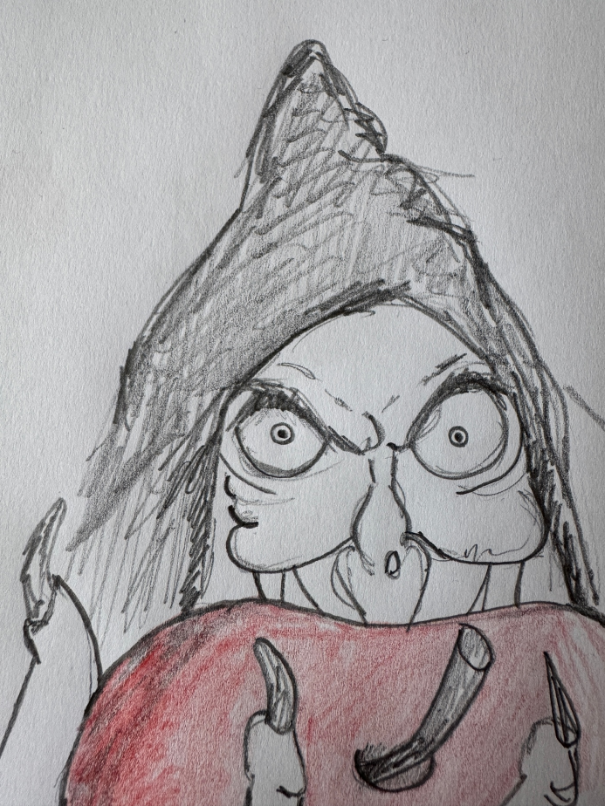
The first image (December 2014) in a chronological sequence features the Witch form, offering an apple with a claw-like hand. This picture bears the exaggerated features familiar from the animated film: long white hair, hunched back, pronounced eyebrows, a large nose with a wart, and prominent wrinkles (Fig. 1). These traits are often associated with masculinity, especially in contrast to her more feminised Evil Queen form.
The consecutive image (October 2017), a black-and-white artwork of the Witch, is similar, but this time her entire body is draped in her iconic black robe. This concealing costume disguises bodily features, blurring gender markers, and functions as a continuation of the 1930s Hollywood queer-coding, where villainous characters signifying deviance were costumed from head to toe, subtly signalling non-normative characteristics without explicit reference to queer identities.
Queer-coding was a consequence of the Hays Code, or the Motion Picture Production Code, which prohibited explicit non-heteronormative features in Hollywood until 1968, but its influence is still prevalent in popular media (Griffin, 2000). The recurring depiction of villainous characters using these queer-coded visual tropes has ethically troubling implications, as it ultimately equates features that deviate from traditional gender norms with evil. Hence, Disney’s continued portrayal of the Evil Queen spreads potentially harmful stereotypes by reinforcing the association between deviance and villainy.
The third image (July 2018) in chronological order portrays the Evil Queen among many other characters. She wears heavy makeup: lipstick, blush, and mascara. Her head and hair are covered by black fabric and a crown, resembling her original look in the animated film. Notably, this stylised depiction is also queer-coded. Her exaggerated facial features, intensified by the heavy makeup, are the opposite of Snow White’s barefaced, natural appearance.
Snow White, the protagonist and an idealised Disney Princess, visually embodies heteronormativity through her bright, feminine clothing, conventionally attractive figure, and gentle facial expression. In contrast, the Evil Queen explicitly performs femininity, which aligns with camp – an aesthetic style closely related to drag that utilises deliberate exaggeration and performativity to destabilise gender binaries (Edward and Farrier, 2020; Escudero-Alías, 2009).
Through the visual binary between the princess and the villainess, the Queen is positioned outside the norms of traditional femininity. This recurring mechanism of othering reflects how Disney generally portrays its villains (Bettanya and Belk, 2011). The Queen’s traits reinforce her role as the symbolic Other, where naturalised femininity marks goodness, while exaggerated, performed femininity signals deviance. Consequently, Disney’s visual culture contributes to the ongoing stigmatisation of gender nonconformity.
Glamorous Queen
The fourth image (July 2018) marks a shift in Disney’s portrayal of the Queen toward glamorisation and sexualisation, showing her in regal form, positioned centrally among other villains as part of a beauty campaign (Fig. 2).
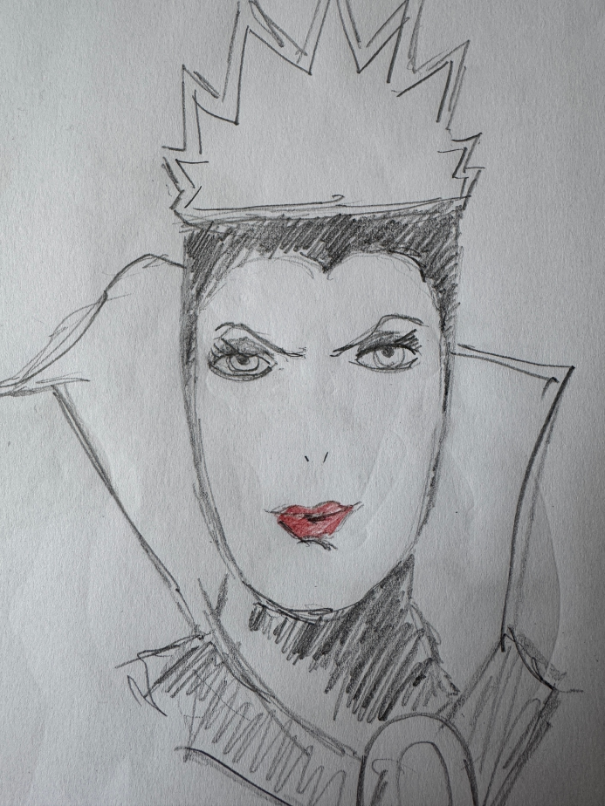
Her high-collared cloak, heavy makeup, and covered body reinforce a hyperfeminised, queer-coded visualisation, as before. Another image (May 2019), an ornate portrait, situates her in an aristocratic context, contrasting with the simpler design of the original animation and supporting her ongoing glamorisation. Ultimately, this trend arguably reflects Disney’s broader reconsideration of villainous characters in the 21
st century.
During this period – which coincides with the analysed posts – Disney’s live-action remakes, such as Maleficent (2014) and Cruella (2021), have introduced redemptive arcs for previously villainised characters. These reinterpretations likely aim to soften or complicate villainy, and the Evil Queen’s Facebook portrayal appears to follow this pattern. Within this framework, the Queen continues to exhibit queer-coded traits, but her image is increasingly framed to appeal to a wide audience, softening her villainous edges and repositioning her as glamorous and aspirational.
In June and August 2019, the Queen appears in several images that depict both menace and glamour. In line with these images, the next post places her next to Snow White. Snow White stands in the light, while the Evil Queen lurks in the shadows (Fig. 3).
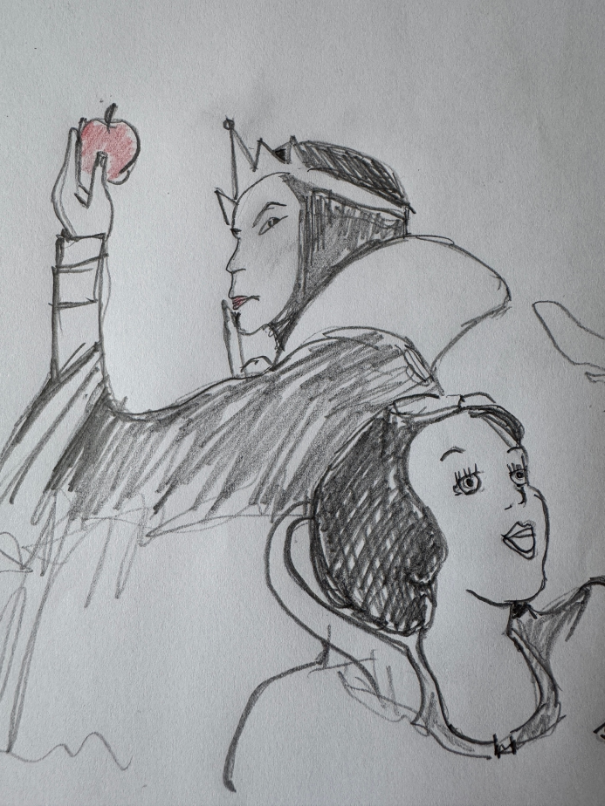
The Queen’s pose, one finger at her chin, and her up-lit face reinforce her as the opposite of the innocent heroine. All in all, these late-2019 representations suggest that Disney is caught between ideologies. On one hand, the company reimagines outdated portrayals in order to align with changing social norms. On the other hand, it continues to rely on familiar and potentially harmful tropes to preserve its tradition.
Interestingly, one of the more glamorous depictions of the Evil Queen was reposted in January 2020. This image had originally appeared in May 2019, and its reappearance just months after a series of more sinister portrayals highlights the duality in how Disney frames the character. The close temporal proximity of these contradictory representations further emphasises how Disney does not appear to be committed to a singular narrative but rather circulates multiple versions to cater to diverse audience expectations.
As part of the culture industry, these portrayals imply a profit-driven logic, where representational choices are not necessarily guided by coherence. Accordingly, from April 2020 to October 2021, the Queen shifts back and forth between softened portrayals, such as a groupings with other Disney royalty where her smile reaches her eyes, and traditional threatening demeanours, as on a book cover (Fairest of All: A Tale of the Wicked Queen [2009]) and a poster for Snow White and the Seven Dwarfs.
A September 2022 official Disney photo of cosplaying fans frames the Queen more openly sexualised, revealing cleavage and softening the character’s visual restraint. This shift could suggest yet another reframing of the Evil Queen. The next post (October 2022), and the final one before the reveal of the new live-action Queen, returns to a classic image, a screenshot of the 1937 film in which the Queen appears in her Witch form. This signals yet another nostalgic return to the roots of her menace. Across these posts, Disney seemingly negotiates a tension between tradition and modernisation: familiar villainous traits, glamorisation and sexualisation as part of a strategic branding logic.
Live-Action Queen
From December 2024 onwards, Disney began promoting the upcoming live-action
Snow White (2025), with Gal Gadot cast as the Queen (Fig. 4).
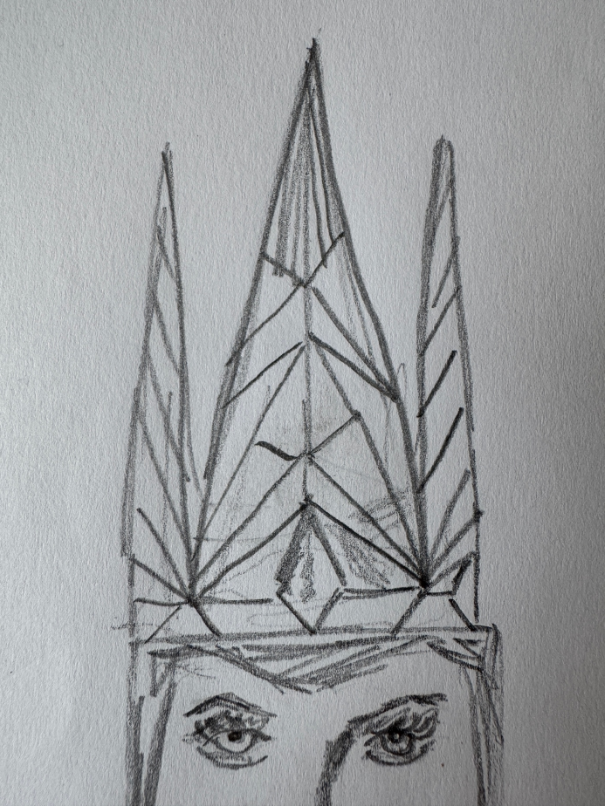
Gadot has been known for her beauty and her former title as Miss Israel; consequently, her Queen merges menace, glamour, and sexualisation into a single composite. In the poster, she is positioned above Snow White, who is wearing “natural” makeup, while the Queen has heavy, dark-toned makeup, a gem-encrusted crown, and sharply pointed nails. Additionally, in March 2025, Disney posted stills from the film that show the Queen smiling with her eyes, posing neutrally with glittering gems all over her body, or conjuring power. The final still depicts her holding a sceptre and staring into the Mirror with a stern gaze.
These live-action stills differ from earlier Facebook posts: they are part of a coordinated marketing campaign tied to a major theatrical release, showcasing Disney’s synergy, rather than casual social media engagement. The images therefore draw from decades of evolving depictions, seemingly reflecting Disney’s attempt to modernise the character while still capitalising on her iconic status. The result is a fragmented and sometimes contradictory portrayal.
The last image analysed, posted in April 2025 just after the premiere of Snow White, returns to the original 1937 animated Queen. This return signals a visual cycle and a strategic response to the backlash surrounding the live-action adaptation. Disney appears to be attempting to calm critical viewers and re-establish a sense of continuity with its nostalgia.
…and She Lived Happily Ever After.
This blog post has traced how the Evil Queen’s gender identity has been visualised and how it shifted across a decade of still images on Disney’s official Facebook page. From sinister to glamorous, camp, and sexualised, these representations reflect Disney’s negotiation between tradition, profit, changing social values, norms, and political dynamics. The newest iteration, the live-action Queen, merges past aesthetics outlined in the analysis of previous images into a composite that is ideologically fragmented, revealing much about Disney’s likely branding strategies, torn between conflicting ideals. However, a limitation of my approach is that it can only offer interpretive inferences about Disney’s intentions behind these shifts.
The Queen’s digital afterlife illustrates how the culture industry circulates and reinforces visual norms and stereotypes around femininity, operating with queer-coded tropes from 1930s Hollywood films. These portrayals are highly problematic, as they continue to shape audience perceptions of gender and deviance. How, then, might we, as cultural consumers, make sense of these recurring cycles of menace, glamour, and sexuality?
References
- Bettany, S., & Belk, R. W. (2011). Disney Discourses of Self and Other: Animality, Primitivity, Modernity, and Postmodernity. Consumption Markets & Culture, 14(2), 163-76. https://doi.org/10.1080/10253866.2011.562017.
- Cruzl, E. G., & Thornham, H. (2015). Selfies Beyond Self-Representation: The (Theoretical) F(r)ictions of a Practice. Journal of Aesthetics & Culture, 7(1), 1-10. https://doi.org/10.3402/jac.v7.28073.
- Edward, M., & Farrier, S. (2020). Drag: Applying Foundation and Setting and Scene. In M. Edward and S. Farrier (Eds.), Contemporary Drag Practices and Performers: Drag in a Changing Scene Volume 1 (pp. 1-18). Methuen Drama.
- Escudero-Alías, M. (2009). Long Live the King: A Genealogy of Performative Genders. Cambridge Scholars Publishing.
- Griffin, S. (2000). Tinker Belles and Evil Queens. New York University Press.
- Hall, S. (1997). Introduction. In S. Hall (Ed.), Representation: Cultural Representations and Signifying Practices, (pp. 1-11). Sage Publications & Open University.
- Wohlwend, K. E. (2012). The Boys Who Would Be Princesses: Playing with Gender Identity Intertexts in Disney Princess Transmedia. Gender and Education, 24(6), 593-610. https://doi.org/10.1080/09540253.2012.674495.
* Kamilla Péter is a master’s student in the CREOLE Program at the Department of Social-Cultural Anthropology, University of Vienna.