
Avishek Ray*
In our everyday scrolling—through Instagram, WhatsApp, Snapchat, or Facebook—the selfie often appears as something both mundane and omnipresent. Whether taken against a scenic backdrop, filtered for aesthetic effect, snapped for bureaucratic ID verification, or shared in moments of vulnerability or joy, the selfie has moved far beyond the status of a casual photograph. It has become a vital mode of self-expression, identity crafting, and social communication.
But what happens when we pause to take the selfie seriously—not just as a cultural curiosity or a passing digital trend, but as a complex socio-technical practice that both reflects and produces new ways of being in the world?
Our book sets out to do study this. Through a series of five interlinked chapters, we examine the selfie as more than a visual or aesthetic form. We approach it as a cultural artifact, a political expression, a technological interface, and a situated performance of identity. Rather than treating the selfie as simply a modern twist on the traditional portrait or photograph, we argue that it represents a shift in how selfhood is produced, mediated, and experienced in the digital age. The selfie, in our view, is not just a snapshot of who we are—it is an act of becoming, a performance in motion, and a tool of negotiation with the multiple forces that shape our lives.
In this context, Nishant Shah (2018) reminds us that selfies do more than show us—they can conceal, refer only to themselves, or even erase the person behind the image while still asserting presence. Along similar lines, Usha Raman (2024) views the selfie as “a way of making oneself as we make our place in the world,” a bid not just for visibility but for belonging in the digital age. These insights come alive when we look at what the SelfieCity project found out across five global cities. Their rigorous analysis showed that only 3–5% of Instagram photos are actually selfies—far fewer than most of us might assume. Among these, women dominate; females tend to take more selfies than their male counterparts. Age-wise, most selfie-takers are young—in their 20s.
But it’s not just about who takes them: emotions show up, too. People in certain places appear happier than others. Together, Shah, Raman, and SelfieCity invite us to see selfies not simply as snapshots, but as digital gestures that conceal, amplify, express, and negotiate identity, shaped by culture, gender, emotion, and geography. Emerging from a three-year, funded research collaboration between scholars in India and the UK, our book carries this line of argument forward, deepening and expanding its scope.
At the heart of our analysis is a methodological approach that bridges the digital and the grounded.
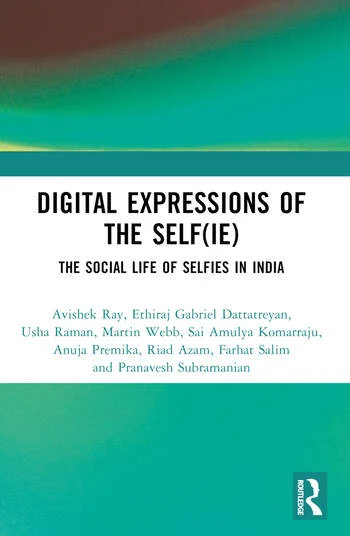
Cover of Digital Expressions of the Self(ie): The Social Life of Selfies in India (Routledge, 2024).
While selfies primarily circulate as digital images on social media platforms, their meanings are deeply entangled with offline, embodied contexts. To capture this dual nature, we bring together digital ethnography—immersive engagement with platforms like Instagram, Facebook, and WhatsApp—with traditional, place-based ethnographic fieldwork in Indian urban settings such as Delhi and Kolkata.
This mixed methodology allows us to trace how selfies operate as socio-cultural performances unfolding simultaneously online and offline, mediated by both digital infrastructures and lived social realities. For instance, in Delhi, we observe how young men create choreographed Instagram Reels to enact and display specific forms of masculinity. These visual performances are not limited to the digital realm; they are often staged in specific urban hotspots—parks, plazas, metro stations—where digital production and physical spatiality intersect.
By combining close analysis of visual content with on-the-ground observations and interviews, we show how masculinity is both crafted and contested through these selfie practices. In another chapter, we examine how selfies have become tools of workplace surveillance, particularly among sanitation and domestic workers. Here, the selfie takes on an entirely different valence—not as a mode of self-expression, but as a compulsory digital trace used to monitor labor, discipline bodies, and enforce accountability in hierarchical work settings
Across these varied sites, we explore the selfie as a site of negotiation—between self and audience, body and interface, visibility and privacy, labor and leisure. Our five chapters delve into distinct but interrelated aspects of selfie cultures:
- stylized male performances of urban aspiration and dominance in Delhi;
- the spatial politics of “Insta-worthy” cafés and leisure spaces in Kolkata, which shape consumer behaviors and urban aesthetics;
- the deployment of selfies as instruments of workplace control and biometric governance;
- the circulation of selfies in death, particularly how posthumous images construct digital legacies and public mourning; and
- the emergence of object-based or faceless selfies that resist conventional norms of self-presentation by substituting the face with symbols, objects, or text.
These inquiries are rooted in the rapidly transforming digital landscape of India, where smartphone access and data connectivity have expanded dramatically over the past decade.
The selfie, in this context, intersects with urgent questions of caste, class, gender, region, language, and digital literacy. Who gets to be visible? Who is encouraged to curate and perform a self for online platforms—and who is excluded or punished for doing so? By situating the selfie within these social hierarchies, we foreground its uneven politics, even as we recognize its global relevance. Themes like intimacy, algorithmic visibility, and digital performativity may take particular shape in India, but they resonate far beyond national borders.
By treating the selfie as both a site of self-making and a medium of world-making, we ask: What does it mean to be “seen” in the digital age? What kinds of selves are possible when the mirror is always networked, always watching, always recording? And how do these digitally mediated selves reshape our relationships with each other, with institutions, and with public space? Tracing the social life of selfies in India—from the playful to the political, the intimate to the institutional—we offer a grounded, interdisciplinary, and theoretically rich account of how selfies become more than personal artifacts. They are, we argue, public gestures and infrastructural practices that shape how we experience identity, community, and visibility in the twenty-first century.
Historically, self-representation has been a privileged act, reserved for the elite. Artists, writers, and statesmen crafted carefully curated self-images through oil paintings, memoirs, or official portraits to stake claims to posterity and public recognition. In contrast, the contemporary selfie has democratized this act—while simultaneously embedding it within the logics of platform capitalism. Enabled by smartphone cameras, filters, and apps, the selfie is produced through layers of technological mediation: it is a digital object embedded in platform economies, governed by algorithmic curation, and circulated through hashtags, likes, comments, and shares. It is shaped by both personal intention and impersonal code.
Selfies, we therefore argue, are not mere representations of a pre-existing self; they are technologies of self-production.
A Tinder selfie might spotlight confidence or charm; a LinkedIn photo might convey professionalism; a Snapchat image sent to a friend might express humor or spontaneity. Each enacts a distinct version of “self,” calibrated to platform-specific norms and expectations. Unlike conventional photographs, selfies are immediate, modifiable, and dialogic. They are crafted with multiple audiences in mind—including algorithmic agents that shape visibility and reach.
We use the term “self(ie)”—with parentheses—to mark the co-constitution of self and image. The act of taking, editing, and posting a selfie is not simply reflective, but constitutive: it assembles subjectivity through cycles of mediation and feedback. Tools like filters, facial recognition, and comment threads shape both how we see ourselves and how we are seen. As responses accumulate—affirming, hostile, playful, or critical—self-presentation becomes an ongoing process of adjustment and curation. The digital self is never static; it is continually in the making.
Our book is driven by questions:
- How do digital technologies reshape practices of selfhood and visibility?
- What subjectivities, desires, and anxieties emerge through selfies?
- How do visual self-representations transform relationships, places, and power dynamics?
Drawing from anthropology, media studies, performance and feminist theory, surveillance studies, and digital humanities, we situate these inquiries within case studies from contemporary India—where rapid digital expansion intersects with enduring socio-economic inequality.
Rather than propose a single theory of the selfie, we offer a set of interpretive frameworks to explore its contradictory roles: as both norm-reinforcing and subversive, playful and disciplinary, empowering and extractive.
Selfies mediate intimacy and desire while serving institutional and bureaucratic ends. Their meanings shift across contexts, intentions, and platforms. While often dismissed as narcissistic or frivolous, the selfie is a powerful cultural form embedded in infrastructures of technology, capital, and care. It traverses boundaries between public and private, affect and data, freedom and control.
Through ethnographic insight and critical theory, we approach selfies not merely as images, but as acts—performances of self shaped by technologies, social relations, and global inequalities. In doing so, we illuminate not only how we present ourselves, but how we participate in remaking the world.
References
- Shah, N. (2018). The Selfie is as the selfie does: Three Propositions for the Selfie in the Digital Turn. In Blaney, A., & Shah, C. (Eds.). Photography in India: From Archives to Contemporary Practice (pp.177-193). London: Routledge.
- Raman, U. (2024). Inhabiting the Selfie: Notes from India’s “Selfie Culture”. India in Transition. Center for the Advanced Study of India, University of Pennsylvania. https://casi.sas.upenn.edu/iit/usha-raman (Accessed: 10 August 2025).
- Ray, A., Dattatreyan, E. G., Raman, U., Webb, M., Gupta, N., Komarraju, S. A., Premika, A., Azam, R., Salim, F., & Subramanian, P. (2024). Digital Expressions of the Self(ie): The social life of selfies in India. Routledge.
- SelfieCity Project. (2014). SelfieCity. https://selfiecity.net (Accessed: 10 August 2025).
* Avishek Ray is an Associate Professor at the National Institute of Technology Silchar, India. His research interests include cultural studies, media theory, and digital humanities.